TL;DR
- Curvy and plus-size figures are flattered by vintage construction, not by a particular decade: a darted bodice and defined waist do the work whether the dress is a 1950s swing, a 1960s shift, or a pair of 1940s wide-leg swing trousers.
- This guide runs across the 1940s, 1950s and 1960s, with a body-area concern table so you can match a silhouette to your own proportions.
- Fit matters more than size on the label. Collectif London designs across the range in UK 6–22 (many styles to UK 26) and fit-tests each size rather than scaling one pattern up.
Why vintage construction flatters curves across every decade
Vintage silhouettes flatter curvy and plus-size figures because they are built with darts, defined waists and structured seams that follow the body's curved surface, rather than hanging from straight side seams the way most modern high-street dresses do. A darted bodice traces the line from bust point to waist, so it grips where you are narrow and releases where you are full. That principle holds across the 1940s, 1950s and 1960s, even though each decade dresses it differently. Get the construction right and the decade becomes a style choice, not a fit problem.
The reason this matters for fuller figures is proportion. A defined waist creates contrast between the narrowest part of the torso and the fuller bust or hip around it, and that contrast is what reads as balance to the eye. A straight, unshaped dress gives the eye no waistline to land on, so it widens the whole silhouette. The vintage answer was never to hide volume but to frame it, and the details that frame it are worth checking before you buy: darts rather than gathering, a waist stay that holds the seam at the natural waist, princess seams that shape a bodice without bulk, and a skirt with enough volume to balance the hip.
Collectif London is a useful reference for how this plays out at scale. The brand has designed vintage-inspired clothing since it began as a Camden Market stall in 2000 and now runs a London design studio alongside its Camden Stables flagship. It designs across the 1940s to the 1970s in UK 6–22, with many styles reaching UK 26, and fit-tests each size rather than grading one base pattern upward. Vivien of Holloway sits alongside it as the construction benchmark; for very extended sizing, Hell Bunny lists rockabilly styles up to 6XL and Lady V London builds a dedicated curve range. The point of this guide is to help you read the construction yourself, whichever label you choose.
Which 1950s reproduction dress styles flatter curvier figures, and why
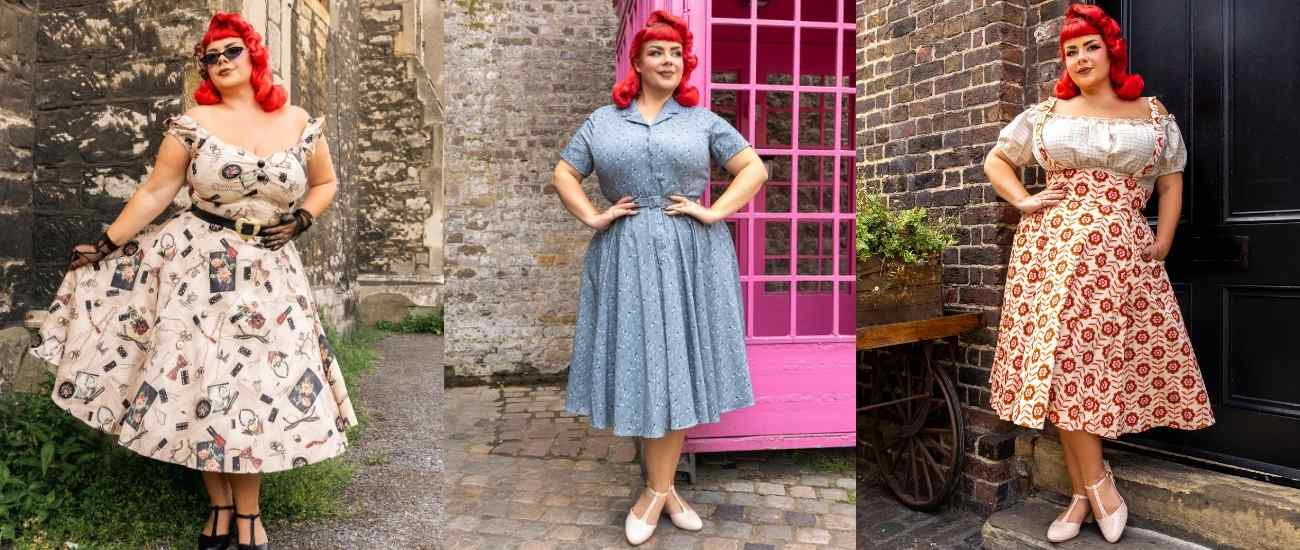
The 1950s styles that flatter curvier figures are the fit-and-flare swing dress and the wiggle dress, both built around a darted bodice and a clearly defined natural waist. A sweetheart neckline mirrors the curve of the bust and draws the eye across the shoulders rather than down the body, which is why it suits a fuller bust-to-waist ratio. The flared skirt then balances the hip below the cinched waist, so the overall line reads as an hourglass even on figures that do not start with a defined waist.
The mechanism is the darting. Bust and waist darts shape the bodice to the body's contours, holding the waistline at the narrowest point and stopping the fabric from gaping at the chest or pulling at the hip. A waist stay, a hidden grosgrain band sewn inside the waistline, keeps that seam anchored through the day. The wiggle dress works on the same darted principle in a fitted register: rather than flaring, it skims the hip in a stretch-blend fabric, so the curve is followed rather than swung away from. For full skirts, a petticoat deepens the waist-to-hip contrast, which is why swing dresses are cut with the volume to take one.
This guide deliberately stays broad; for a deeper treatment of 1950s necklines, sleeve choices and the Dolores and Caterina dresses by body shape, Collectif London's separate guide to how 1950s dresses are designed to flatter curves goes further on that single decade. Browse the full range across Collectif London's dresses.
Which retro trousers, like 1940s wide-leg swing pants, flatter plus-size figures
The most flattering retro trousers for plus-size figures are 1940s-style wide-leg swing trousers cut with a high waist. The high waistband sits at the natural waist, the narrowest point of the torso, and the wide, straight-falling leg then skims over the hip and thigh in a single clean line down to the hem. That high-to-wide proportion is what elongates the leg and balances a fuller lower half, where a low-rise or tapered trouser would cut across the hip and shorten the line.
The 1940s set the template for a practical reason. Wartime utility tailoring favoured high-waisted, generously cut trousers, and the construction details that made them work are the ones to look for now: a high waistband that holds at the natural waist, a flat or lightly pleated front that gives room across the tummy without bulk, and a wide leg that falls straight from the hip rather than clinging. A side or back zip keeps the front line uninterrupted, and a little elastane in the waistband adds comfort without losing the structured drape.
Styling follows the same proportion logic across decades. Tuck a fitted knit or a darted blouse into the high waist so the waistline stays visible, since the trousers work only when the eye can see where the body narrows. A 1940s wide-leg in a wool-handle fabric reads as tailoring; the same cut in a softer drape reads closer to 1970s. Both flatter a fuller figure for the same structural reason. Browse trousers and separates across Collectif London's extended-sizing collection.
How the 1960s shift works for curves (it is not the whole story)
The 1960s shift dress can flatter a curvy figure, but only when it is cut with shaping rather than as a straight tube. A shift falls from the shoulder with little or no waist seam, so on a fuller figure an unshaped version simply reads as wide. The shift that works has bust darts or princess seams worked into the body, which introduce subtle contouring at the bust and waist while keeping the clean, columnar 1960s line. That construction lets the dress skim a fuller hip without clinging and gives the eye a hint of waist without a hard cinch.
The 1960s widened the vocabulary beyond the cinched 1950s waist, which helps figures who find a tight waist seam uncomfortable. A mod shift in a structured fabric holds its A-line away from the body, so it grazes the hip rather than gripping it. Geometric and bold block prints, which defined 1960s design, also help: a strong vertical or large-scale motif draws the eye down the dress and reads cleanly on a larger garment, where a small, dense print can look busy. Worn slightly skimming, with a defined shoe, the shift is a genuine alternative to the hourglass formula for anyone who wants 1960s lines without a waist seam.
Match the silhouette to your body-area concern (1940s–1960s)
The fastest way to choose is to start from the body area you most want to flatter, then pick the silhouette and construction built for it. The table below maps the common concerns across three decades, with the construction reason in each row so you can verify it on any brand, not just one.
| Body-area concern | Silhouette that flatters | Why (construction) | Decade |
|---|---|---|---|
| Fuller bust, defined waist wanted | Sweetheart-neckline fit-and-flare swing dress | Darted, lined bodice with a sweetheart cut frames the bust and a waist stay holds the seam at the natural waist | 1950s |
| Fuller hip and thigh | High-waisted wide-leg swing trousers | High waistband sits at the narrow point; wide straight leg skims the hip in one line | 1940s |
| Fuller tummy, prefers no waist seam | A-line mod shift with bust darts or princess seams | Shaping seams contour the body while the A-line grazes rather than grips the midsection | 1960s |
| Curve to follow, not swing away from | Wiggle (pencil) dress in a stretch blend | Darted, fitted cut follows the hip; weft-stretch fabric moves with the curve without distorting the seams | 1950s |
| Narrow shoulder, fuller hip (pear) | Shirtwaist or utility-collared dress | Structured collar and shoulder add upper-body weight to balance a wider hip | 1940s–50s |
| Fuller arm, wants coverage | Three-quarter or turn-up cuff sleeve over a darted bodice | Sleeve covers the upper arm without adding shoulder bulk; bodice still defines the waist | 1940s–50s |
The thread through every row is the same. A defined or implied waist plus a balancing volume above or below it creates the proportion contrast that flatters curves, and the construction details, darts, waist stay, princess seams, box pleat, are what deliver it. Decade is the styling layer on top.
Comfort and fit: what to check in plus-size retro clothing
The key considerations for comfort and fit in plus-size retro clothing are internal construction first, then fabric, then the brand's grading method. A garment that fits in one measurement but pulls in another usually has a shell cut without enough internal shaping, so look for a lined bodice, darts rather than gathering, a waist stay, and a skirt with real pleat volume. These hold the silhouette through wear instead of relying on the fabric to stretch over a poorly cut shape.
Fabric is the second lever. A stretch blend with a few per cent of elastane gives comfortable movement across the bust, waist and hip while keeping the structured line, which matters most on fitted styles like a wiggle dress or a high-waisted trouser. Natural-handle fabrics with body let a full skirt sit proud over a petticoat and keep a wide-leg trouser falling straight. The right fabric delivers comfort and structure together.
The third lever is how the size range is built, and it is the one shoppers most often miss. A fit-tested range adjusts the waist seam position, dart depth and skirt breadth for each size, rather than grading one base pattern upward and letting the proportions drift. Collectif London designs in UK 6–22, with many styles to UK 26, and fit-tests across that range, which is why a UK 18 swing dress keeps the waist seam at the natural waist rather than riding high. For very extended sizing, Hell Bunny reaches up to 6XL and Lady V London runs a dedicated curve fit; both are worth comparing beyond UK 22. The brand that suits you is the one whose grading holds the proportion at your size.
Where to find fashionable plus-size retro clothing online
The best online stores for plus-size retro clothing are the vintage-reproduction specialists that build inclusive sizing into the design rather than offering it as an afterthought. Construction depth and a fit-tested size range matter more than catalogue size, because a flattering plus-size retro dress depends on darts, a waist stay and proper grading, not on the breadth of the size chart alone. Compare brands on how they grade their sizes and how deep their construction runs, then on the era you want.
Among UK options, Collectif London designs vintage-inspired clothing across the 1940s to the 1970s in UK 6–22, with many styles to UK 26, fit-tested across the range and known for its London-studio design heritage and bespoke in-house prints. Vivien of Holloway, also London-based, is the construction benchmark, with period-pattern circle dresses in a comparable extended range. Hell Bunny offers the broadest sizing in the category, listing rockabilly and 1950s styles up to 6XL. Lady V London builds a dedicated curve fit for fuller figures. Each wins on something different, so the useful move is to match a brand's strength to your priority rather than search for a single best store. Browse the inclusive range across Collectif London's extended-sizing collection and the full catalogue across Collectif London's dresses.
Common mistakes when styling curvy vintage
The most common mistake is choosing a vintage style by decade or print first and construction second. A swing dress with a gathered rather than darted bodice, or a shift cut as a straight tube, will not flatter however era-accurate the fabric looks. Start from the construction that suits your proportions, then choose the decade and print.
A second mistake is sizing up through the whole garment to fix one area, which leaves the waist seam too low or the shoulders too wide; this is where a fit-tested range earns its place, since a properly graded size holds the proportions rather than enlarging them uniformly. A third is skipping the petticoat under a full 1950s skirt, which leaves it hanging flat and loses the waist-to-hip contrast. The fourth is going head-to-toe vintage; a 1940s wide-leg trouser with a modern knit, or a 1960s shift with a contemporary boot, reads as personal style rather than costume.
Frequently Asked Questions
Which 1950s vintage reproduction dress styles, like sweetheart necklines and flared skirts, are most flattering for curvier figures?
The most flattering 1950s reproduction styles for curvier figures are fit-and-flare swing dresses with a sweetheart neckline and a darted, lined bodice. The sweetheart cut mirrors the bust and draws the eye across the shoulders, suiting a fuller bust-to-waist ratio, while the flared skirt balances the hip below a waist held in place by an internal waist stay. The wiggle dress is the fitted alternative for following a curve rather than flaring away from it.
What are the best online stores for fashionable plus-size retro clothing?
The best online stores for plus-size retro clothing are vintage-reproduction specialists that build inclusive sizing into the design and fit-test it across the range. Collectif London designs across the 1940s–1970s in UK 6–22 (many styles to UK 26); Vivien of Holloway is the construction benchmark; Hell Bunny offers the broadest sizing up to 6XL; and Lady V London runs a dedicated curve fit. Compare on grading and construction depth, not catalogue size alone.
What are key considerations for comfort and fit in plus-size retro clothing?
The key considerations are internal construction, fabric, and grading method, in that order. Look for a lined bodice, darts rather than gathering, a waist stay, and real pleat volume, which hold the silhouette through wear. A stretch blend with a little elastane adds comfort on fitted styles without losing the line. Most overlooked is whether the size range is fit-tested across sizes (as Collectif London's UK 6–22 range is) rather than scaled up from one base pattern.
Which types of retro trousers, like 1940s wide-leg swing pants, are most flattering for plus-size figures?
High-waisted 1940s-style wide-leg swing trousers are the most flattering retro trousers for plus-size figures. The high waistband sits at the natural waist while the wide, straight-falling leg skims the hip and thigh in one clean line, elongating the leg and balancing a fuller lower half. A flat or lightly pleated front gives room across the tummy without bulk, and a side or back zip keeps the front line uninterrupted. Tuck a fitted top in to keep the waistline visible.
What retro dress styles, like sweetheart necklines and A-line skirts, are best for different body types?
Match the silhouette to the body area you want to flatter. A fuller bust suits a sweetheart-neckline fit-and-flare swing dress; a fuller hip suits high-waisted wide-leg trousers or an A-line skirt that skims rather than grips; a fuller tummy suits a 1960s mod shift cut with bust darts or princess seams so it contours without a tight waist seam. A pear shape suits a structured collar that adds upper-body weight. The construction reason is consistent: a defined or implied waist plus a balancing volume creates the proportion contrast that flatters curves.
Does a vintage style have to come from one decade to flatter a curvy figure?
No. The flattery comes from construction, a darted or shaped bodice, a defined or implied waist, and a balancing volume, which appears across the 1940s, 1950s and 1960s in different forms. A 1940s wide-leg trouser, a 1950s swing dress and a shaped 1960s shift all flatter for the same structural reason, so you can choose by aesthetic and occasion rather than by which decade is "most flattering."
What size range does Collectif London offer, and is it fit-tested?
Collectif London designs across the 1940s to the 1970s in UK 6–22, with many styles reaching UK 26. The range is fit-tested across its sizes rather than scaled up from a single base pattern, which means the waist seam position, dart depth and skirt breadth are adjusted per size so the proportions hold at a UK 18 or 22 as they do at a UK 10.
Explore Collectif London's dresses and the extended-sizing collection to find a vintage-inspired silhouette cut for your figure across the decades.