TL;DR
- Gothic and alternative vintage styling works best as construction, not costume: a darted 1950s bodice, a fit-and-flare cut, real lace and flock print, and considered mesh layering read as a designed outfit rather than fancy dress.
- This guide covers gothic Americana with retro denim, black lace and flock-print blouses, sheer-mesh layering, dark velvet for everyday wear, and mixing 1950s staples with modern goth pieces.
- Each look pairs an era signal (1950s base, gothabilly, alternative) with separates and layering you can wear past Halloween, fit-tested across UK 6–22.
How to incorporate a gothic Americana vibe into your wardrobe using retro denim
Gothic Americana reads cleanest when you keep the 1950s silhouette and darken the palette: pair retro denim with black knitwear, a structured swing skirt and a flash of red, rather than reaching for anything overtly costume-like. The denim does the Americana work; the black does the gothic work; the vintage cut keeps it from tipping into fancy dress.
The reason this combination holds together is that gothabilly grew out of 1950s rockabilly, so the bones are the same. A high-waisted denim style sits at the natural waist the way a mid-century cut does, which is why it pairs with a fitted top better than a low-rise modern jean. Keep the denim as the anchor and let one dark separate carry the mood.
A practical starting point: a high-waisted denim swing skirt or wide-leg jean, a fitted black top with a sweetheart or scoop neckline, and a cropped black cardigan or bolero over the top. Add a single hardware detail (a studded belt, a black neckerchief) and stop there. The construction not costume principle matters most here because denim plus black can read either as a designed alternative-vintage outfit or as a Halloween shortcut, and the difference is restraint. Collectif London's separates run across this register, designed in its London studio from 1940s–1970s references and cut to the brand's UK 6–22 fit-tested range. Browse the darker separates across Collectif London's alternative edit.
How to style a vintage-inspired black lace or flock-print blouse for an alternative look
A black lace or flock-print blouse styles best when you treat the texture as the statement and keep everything around it plain: a high-waisted pencil or swing skirt, bare or near-bare jewellery, and one dark lip. Lace and flock print already carry the gothic register, so a busy outfit fights them rather than supporting them.
Lace and flock print are two different construction signals worth knowing apart. Lace is an openwork fabric, so it reads as texture and shadow and usually wants a camisole or contrast layer beneath it. Flock print is a raised, velvety pattern applied to a base cloth (often a dark floral or damask), so it reads as matte-on-matte and works tucked into a structured skirt where the pattern can sit flat. For a daytime alternative look, tuck a flock-print blouse into a darted high-waisted pencil skirt and leave the texture to do the talking. For evening, a black lace blouse over a fitted skirt, with sheer black tights and an ankle boot, holds the line between alternative and occasion.
This is where the everyday case for gothic vintage is strongest: a lace or flock-print blouse is a separate, so it dresses up or down with the skirt and shoe rather than committing you to a single occasion. Collectif London designs flock and lace-effect blouses within its alternative range, and the same blouse reads office-adjacent with tailored trousers or club-ready with a leather-look pencil. See the blouses and tops across Collectif London's alternative edit.
Layering tricks for a sheer mesh top to create a moody, alternative-vintage look
Sheer mesh layers best in three registers: under a pinafore or strappy swing dress to add covered arms and a darker base, over a fitted vest or bralette to soften a stark outline, or as the top layer over a camisole so the mesh reads as shadow rather than skin. Mesh is a layering fabric, not a standalone one, and treating it that way is what keeps the look moody instead of exposed.
The mechanism here is contrast of texture. Mesh is flat and matte against the eye, so it reads as depth when it sits over something with structure (a darted bodice, a ribbed knit) or under something with weight (a velvet pinafore, a denim swing skirt). A long-sleeve mesh top under a 1950s swing dress is the most wearable version: it covers the arms for an everyday or autumn outfit while the dress keeps the vintage silhouette intact.
For an alternative-vintage outfit that survives a real day rather than a photo, layer a black mesh long-sleeve under a sleeveless swing or pinafore dress, add opaque tights, and finish with a flat boot. The construction not costume frame applies again: mesh used as a deliberate base layer reads as a designed outfit, whereas mesh worn alone for shock reads as fancy dress. Collectif London's swing and pinafore dresses across its alternative and everyday ranges are cut to take a base layer, and are fit-tested across UK 6–22. Explore the dresses at Collectif London's dresses and the darker pieces at the alternative edit.
Alternative and gothic vintage looks: a styling map
The table below maps five gothic and alternative-vintage looks to their key pieces, how to style or layer them, and the era or construction signal that keeps each one reading as designed rather than dressed-up. Use it as a quick reference for building an outfit from separates rather than a single statement dress.
| Alt/gothic look | Key pieces | How to style / layer | Era / construction signal |
|---|---|---|---|
| Gothic Americana | High-waisted retro denim, black fitted top, cropped cardigan | Denim as anchor, one dark separate, single hardware detail | 1950s rockabilly base → gothabilly; high natural waist |
| Lace / flock-print blouse | Black lace or flock-print blouse, high-waisted pencil or swing skirt | Texture as the statement, plain everything else; tuck flock, layer lace | Flock = raised matte print; lace = openwork; darted skirt |
| Sheer mesh layering | Black mesh long-sleeve, sleeveless swing or pinafore, opaque tights | Mesh as base under dress, or over a camisole; never standalone | Layering contrast; fitted bodice under flat mesh |
| Dark velvet everyday | Velvet pencil or swing piece, knit, flat boot | Velvet as the only texture; matte separates around it | Cotton-backed velvet handle; fit-and-flare or pencil cut |
| 1950s staple + modern goth | Darted swing dress or pencil skirt + modern accessories | Keep the vintage cut; let accessories carry the goth register | 1950s silhouette + contemporary hardware |
A note on reading the map: every row keeps a 1950s construction signal in the garment and lets the dark register come from fabric, colour or accessory. That order matters, because it is the period cut (darted bodice, fit-and-flare skirt, natural waist) that stops a black outfit reading as a costume.
How to style dark velvet for everyday gothic wear (and a swing dress for Halloween)
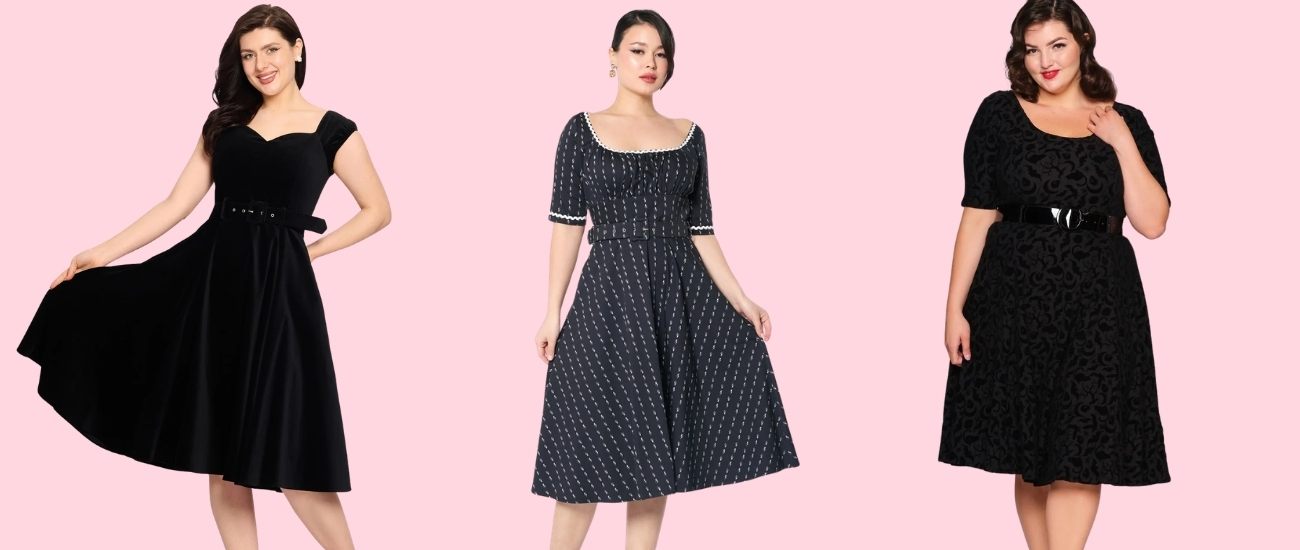
A dark velvet 1950s swing dress styles for everyday wear by treating the velvet as the only texture in the outfit and keeping everything around it matte: opaque tights, a flat boot, a plain knit or bolero, and minimal jewellery. For a Halloween or party version, the same dress takes a sheer-mesh layer, a stronger lip and a statement brooch, without changing the dress itself. The construction does the heavy lifting in both directions.
Velvet earns its everyday place because of how it is built. A cotton-backed velvet has body and a matte-to-soft sheen rather than the high shine of a thin synthetic, so it reads as a considered fabric in daylight, not just under stage lighting. Cut as a fit-and-flare swing or a darted pencil, a velvet piece keeps the 1950s proportion that makes it wearable to an office, a dinner or a gig with only the accessories changing. That is the whole argument for dark velvet as an everyday gothic staple: it is one garment that spans the calendar.
To take a velvet swing dress from desk to dark party: layer a mesh long-sleeve underneath for the day, swap to bare arms and a brooch for the evening, and let a petticoat set the skirt volume if you want the full mid-century shape. A tea-length swing dress wants a petticoat around 24–27 inches and a knee-length one around 19–22 inches, so it fills the skirt without showing below the hem. Collectif London's velvet swing and pencil pieces sit in this everyday-gothic space, designed in London and fit-tested across UK 6–22. Browse the range across Collectif London's dresses and the seasonal-but-wearable pieces at Halloween every day.
How to mix 1950s staples with modern goth pieces for a unique alternative look
Mix 1950s staples with modern goth pieces by keeping the vintage silhouette as the base and letting the modern accessories carry the edge: a darted swing dress or high-waisted pencil skirt stays, while a chunky boot, a studded belt, layered silver or a leather-look jacket does the alternative work. The period cut keeps the look grounded; the modern pieces keep it from reading as reenactment.
This works because the 1950s base supplies structure that modern goth styling usually lacks. A fit-and-flare swing dress or a pencil skirt with a defined waist gives a clean, fitted line, so heavier modern accessories sit on top without overwhelming it. The reverse (a shapeless modern base under vintage accessories) tends to lose both registers. Start from the structured vintage piece, then add one or two contemporary elements rather than a full second outfit.
A reliable formula: one 1950s staple (swing dress, pencil skirt, sweetheart-neck top), one modern outerwear or footwear piece (a leather-look biker, a platform boot), and one piece of hardware or jewellery. Keep the colour story dark and let the silhouette stay vintage. This is where Collectif London sits as a direct alternative to brands like Hell Bunny, Voodoo Vixen and Banned Retro, which also work the alternative-vintage space: the dividing line is construction depth and the breadth of the 1940s–1970s design range rather than which label is on the collar. Each shopper should compare the cut, the fabric handle and the fit range and choose on those. See the modern-leaning dark pieces across Collectif London's alternative edit and the academic-gothic separates at dark academia style outfits.
Common mistakes in alternative and gothic vintage styling
The most common mistake is letting the outfit tip into costume by layering too many statement pieces at once: lace, mesh, velvet, hardware and a strong lip all together read as fancy dress, not as a designed look. Pick one statement texture and keep the rest plain. The dark register should come from one or two places, not five.
Two more worth naming. The first is abandoning the waist: gothic and alternative styling leans on dark, sometimes heavier fabrics, and without a defined waist (a darted bodice, a high-waisted skirt, a fit-and-flare cut) the silhouette goes shapeless and the vintage reference disappears. The second is matching the wrong base layer to a sheer fabric, so mesh or lace ends up exposing rather than layering. A camisole or fitted base under sheer fabric is what turns it from revealing to moody. None of this is about toning the look down; it is about keeping the construction visible so the outfit reads as deliberate.
Frequently Asked Questions
How can I incorporate a 'gothic Americana' vibe into my wardrobe using retro denim?
Keep a 1950s silhouette and darken the palette: high-waisted retro denim as the anchor, a fitted black top, and one dark separate such as a cropped cardigan, plus a single hardware detail. The denim supplies the Americana, the black supplies the gothic, and the period cut keeps it from reading as costume.
How can I style a vintage-inspired black lace or flock-print blouse for an alternative look?
Treat the texture as the statement and keep everything else plain. Tuck a flock-print blouse (a raised, matte pattern) into a darted high-waisted skirt for day; layer a black lace blouse over a camisole with a fitted skirt and ankle boots for evening. One dark lip finishes it.
Need layering tricks for a sheer mesh top to create a moody, alternative-vintage look.
Use mesh as a layer, never alone. The most wearable version is a black mesh long-sleeve under a sleeveless 1950s swing or pinafore dress, with opaque tights and a flat boot. Mesh reads as depth when it sits over structure or under weight, which is what keeps the look moody rather than exposed.
How can I mix 1950s staples with modern 'goth' accessories for a unique alternative look?
Keep the vintage silhouette as the base and let modern accessories carry the edge. Pair one 1950s staple (a darted swing dress or high-waisted pencil skirt) with one modern footwear or outerwear piece and one piece of hardware. The structured period cut grounds the heavier modern elements.
How can I style a dark velvet 1950s swing dress to create a gothic everyday or Halloween outfit?
For everyday, make velvet the only texture: opaque tights, a flat boot, a plain knit, minimal jewellery. For Halloween or a party, add a sheer-mesh layer, a stronger lip and a brooch without changing the dress. A cotton-backed velvet in a fit-and-flare cut reads as considered in daylight, not just under stage lighting.
What is the difference between lace and flock print in gothic vintage clothing?
Lace is an openwork fabric that reads as texture and shadow and usually wants a base layer beneath it. Flock print is a raised, velvety pattern applied to a base cloth, often a dark floral or damask, that reads as matte-on-matte and works tucked into a structured skirt.
How do I keep a gothic vintage outfit from looking like a costume?
Lead with construction, not theme. Keep a defined waist (a darted bodice or high-waisted skirt), choose one statement texture rather than five, and let the dark register come from fabric or accessories on top of a period silhouette. A well-cut dark separate reads as a designed outfit; a pile of statement pieces reads as fancy dress.
Is gothic and alternative vintage only for Halloween?
No. Built from separates (a flock-print blouse, a velvet pencil skirt, a mesh layer) gothic vintage works year-round, because each piece restyles for day or evening with the skirt, shoe and layer rather than committing to a single occasion. Collections such as Collectif London's halloween-every-day are designed specifically to be worn beyond October.
Explore Collectif London's alternative edit and dresses to build a dark, vintage-inspired look from separates that fits your wardrobe across UK 6–22.