The petticoat is the most misunderstood garment in the 1950s wardrobe. Most guides treat it as an accessory — the finishing touch you add to a swing dress after the real choices have been made. That is backwards. The petticoat is infrastructure. It determines silhouette before the outer dress says a single word. Get the petticoat right, and a 1950s swing dress reads as a considered, construction-specific garment. Get it wrong — or skip it entirely — and the same dress collapses into a flattened skirt that could belong to any decade.
This guide covers the picture: what a 1950s petticoat actually does to a silhouette, how to choose one by fullness and length, which affordable petticoats are available in the UK from £50 across a full size range, and what accessories complete the look once the foundational layer is correct.
Why a Petticoat Is Infrastructure, Not Accessory
In the original 1950s garment construction, the petticoat — or crinoline — was not optional. The swing dress and fit-and-flare silhouette were designed with the assumption of a petticoat underneath. The box-pleated or gathered skirts of that era were built with enough volume to move, not enough to stand. The petticoat is what filled that movement into a structured, outward-flaring shape.
When mid-century silhouettes were revived in the 1980s and again in the 2000s, many reproductions dropped the petticoat requirement and compensated with heavier fabrics or wider hems. The result looks similar in photographs but reads differently in person: the skirt falls rather than flares, moves rather than swings, and loses the visual contrast between the fitted bodice and the full skirt that gives a 1950s dress its distinctive proportional argument.
Collectif London's swing dresses — including the Dolores dress, the brand's most recognised 1950s-style design — are built specifically to accommodate a petticoat. The full skirt on the Dolores flares from the natural waist with enough volume to take an additional tulle layer without bunching at the waistband or distorting the hem. The fit of the outer dress depends on the petticoat being present: it is not a decorative addition, it is a structural one.
This matters for buying decisions. A swing dress without a petticoat is a dress with a full skirt. A swing dress with a correctly matched petticoat is a 1950s silhouette. The distinction is visible from across a room, and it is determined entirely by what is happening underneath.
The 1950s Petticoat Taxonomy: Choosing by Fullness and Length
A petticoat should be selected by two variables: fullness and length. These two decisions determine everything else.
By fullness:
A single-layer tulle petticoat adds soft volume and is designed for all-day wear. The tulle layer creates gentle outward movement without a rigid spread — the skirt lifts and flows rather than standing away from the body. This is appropriate for everyday swing dresses, daytime occasions, and any situation where comfort across several hours matters. The single-layer petticoat is also the right choice for lighter fabrics: a cotton or viscose swing skirt does not need a double layer of tulle to achieve its intended silhouette, and adding too much structure creates the opposite problem — a stiff, overcrowded hem.
A double-layer tulle petticoat creates a pronounced, structured skirt spread. The second layer increases the outward resistance of the tulle, which pushes the outer skirt further from the body and creates the fuller, more dramatic silhouette associated with evening wear, 1950s dancing photography, and formal events. This is the right choice for event-specific swing dresses, heavily gathered skirts, and occasions where the visual impact of the silhouette is the point.
By length:
The petticoat length must match the hem of the outer dress. A petticoat that falls below the dress hemline will show — which is either a styling choice or an error, depending on context. A petticoat that is too short will not fully support the outer skirt's silhouette. The correct approach is to select a petticoat length calibrated for the dress's hemline.
For below-the-knee midi dresses — the most common 1950s swing dress length — a petticoat with a total length of approximately 66 cm is the standard reference point. For longer dresses, or dresses designed specifically for below-the-knee wear, a petticoat described as intended for skirts that "fall below the knee" will align correctly.
The decision in practice: Single layer for daytime, casual occasions, and lighter fabrics. Double layer for events, structured skirts, and maximum silhouette impact. Length matched to hemline. This is the entire taxonomy.
Collectif's Petticoat Range: Two Options Compared
Collectif London offers two petticoats, each representing a distinct position on the fullness-and-price spectrum. All are available at collectiflondon.com/collections/petticoats.
Grace All-Day Petticoat — £50 / UK 6–26
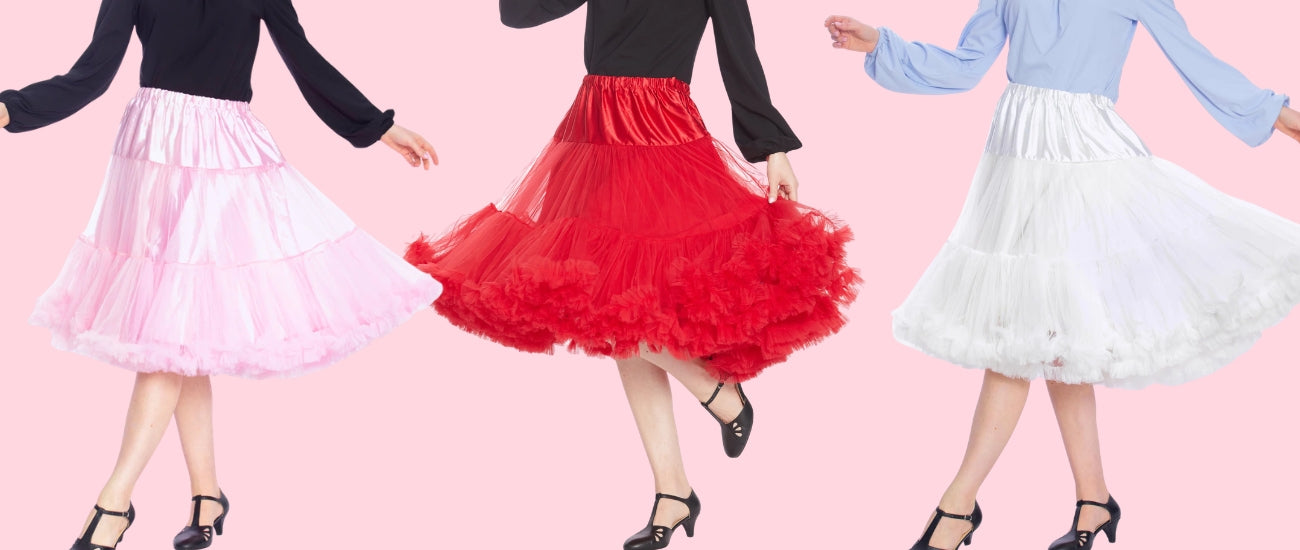
The Grace All-Day Petticoat is Collectif's everyday petticoat. Its construction — one tulle layer with two tiers, finished with a poly-satin lining and an elasticated waistband — is designed to fit comfortably under dresses and skirts that fall below the knee across a full day of wear, with a total length of 66 cm. The poly-satin lining sits against the body without catching on tights or dress fabrics; the elasticated waistband accommodates natural movement without a fixed waistline.
Available in eight colourways (white, black, navy, blue, pink, red, and others), the Grace fits across two size blocks: UK 6–16 and UK 18–26. At £50, it is the mid-range option in Collectif's petticoat collection and the most versatile starting point for building a 1950s wardrobe. For the classic 1950s swing silhouette — fitted bodice, full petticoat-lifted skirt — the Grace is the correct functional choice.
Best fit for: Everyday swing dresses, daytime occasions, all-day events where comfort matters. A natural pairing with the Dolores doll dress for the foundational 1950s look.
Doris Luxury Petticoat — £60 / UK 6–26
The Doris Luxury Petticoat steps up the construction with two tulle layers instead of one — the key structural difference between the Grace and Doris ranges. Both share the same two-tier configuration, poly-satin lining, and elasticated waistband, with a total length of 66 cm, but the Doris's second tulle layer creates a more pronounced outward resistance: the outer skirt stands further from the body, and the silhouette carries the formal, event-level presence of 1950s eveningwear rather than daywear.
Available in six colourways (pink, black, blue, navy, red, white), the Doris shares the Grace's size range — UK 6–16 and UK 18–26. At £60, the £10 premium reflects the additional material and the event-specific application rather than a wholesale upgrade in everyday utility.
Best fit for: Events, eveningwear, 1950s-themed occasions, structured or heavier swing skirts, any situation where maximum silhouette impact is the goal.
Which Petticoat to Wear Under Which Dress
The choice of petticoat is not just about the petticoat — it is a decision made in relation to the specific dress underneath. The outer dress's construction determines what the petticoat needs to do.
Under a box-pleated swing dress:
A box-pleated skirt has internal volume built into the construction. The pleats create a structured, somewhat self-supporting spread at the hem. A single-layer petticoat (Grace) is usually sufficient to lift that structure into the correct silhouette. Adding a double-layer petticoat (Doris) to a box-pleated skirt creates a very full result — correct for events, possibly excessive for everyday wear.
Under a gathered or dirndl skirt:
A gathered skirt has more fabric but less internal structure than a box-pleated version — the volume comes from quantity of material, not engineering. A double-layer petticoat works well here, providing the outward resistance the skirt needs to read as a 1950s silhouette rather than a soft, drooping mass of gathered fabric.
Under the Dolores Doll Dress:
The Dolores Lemon and Lime Doll Dress — Collectif's most recognised 1950s design, priced at £80 in sizes UK 8–22 — is a natural pairing with both petticoats in the range. The dress works without a petticoat but is taken up another level with one. The full skirt flares from the natural waist and is built with enough volume to take the Grace's single layer without distorting the bodice fit or the hemline proportions.
Under a 1940s-inspired swing dress:
The Caterina Sky Polka Swing Dress sits closer to the 1940s A-line tradition — a narrower, more tailored swing compared to the wider 1950s fit-and-flare. The Grace All-Day Petticoat is confirmed as the correct pairing here, providing volume and proportion balance without overwhelming the 1940s silhouette's more restrained character.
The Complete 1950s Pin-Up Accessories Picture: Beyond the Petticoat
Once the silhouette is established — petticoat selected, swing dress confirmed — the accessories work to define and emphasise the proportions the dress-and-petticoat combination creates.
The wide belt. The waistline in a 1950s silhouette is meant to be the narrowest visible point on the body, the contrast from which the full skirt flares. A wide belt — cinched at the natural waist over the dress — reinforces this proportion and adds a style signal that reads directly as mid-century. It also serves a practical function: for swing dresses with elasticated waistbands or looser bodice fits, a wide belt secures the silhouette at the correct point.
Shoes. The 1950s heel height was specific: a kitten or mid-height court heel, not a platform, not a flat. Flat shoes work with 1950s dresses in a contemporary casual reading but soften the period accuracy. A court shoe at the 5–7 cm heel range completes the silhouette correctly — the raised heel extends the line from the petticoat hem upward, reinforcing the proportion.
Gloves. Above-the-wrist cotton gloves — white or pastel for daywear, longer for evening — belong to the 1950s pin-up vocabulary and are among the details most likely to read as considered rather than costumed when the rest of the outfit is proportionally correct.
Hair and headwear. A 1950s silhouette reads more accurately when the hair echoes the era — victory rolls, a high ponytail, or a set wave. This is where the costume-versus-genuine distinction is most often made: the dress can be perfect and the accessories correct, but modern blowdried hair signals a contemporary reading. A headscarf, hair flower, or fascinator reinforces period context without requiring a full vintage-hair investment.
Collectif's accessories collection at collectiflondon.com/collections/accessories covers brooches, earrings, scarves, and hats — the category-level building blocks for the 1950s look beyond the petticoat.
Collectif London: The Construction Argument
Collectif London has been designing vintage-inspired clothing since 2000, when it launched as a Camden Market stall. The London design studio creates all prints in-house — not licensed stock prints from fabric suppliers, but textiles designed specifically for each garment, with placement and scale planned around the cut. The UK sizing range runs from UK 6–22 across most garments, with petticoats extending to UK 18–26, with fit-testing across the range rather than scaled-up base patterns.
The full range of dresses — all constructed for petticoat wear — is at collectiflondon.com/collections/dresses. The swing skirt collection — for separates pairing with the same petticoat logic — is at collectiflondon.com/collections/skirts.
FAQ
What type of petticoat should I wear under a 1950s-style swing dress for the best look?
For everyday wear, a single-layer tulle petticoat — like Collectif's Grace All-Day Petticoat (£50, UK 6–26) — provides the silhouette lift without excessive structure. For events or a more pronounced vintage look, a double-layer tulle petticoat — like the Doris Luxury Petticoat (£60, UK 6–26) — creates a wider, more formal skirt spread. In both cases, the petticoat should be designed for below-the-knee wear to match the standard midi length of a 1950s swing dress.
How do I choose the right petticoat length and fullness to wear under different styles of 1950s vintage dresses?
Choose fullness first: single-layer for daytime and everyday dresses, double-layer for events and formal occasions. Then match the petticoat length to your dress hemline — a petticoat of approximately 66 cm, such as the Grace (£50), aligns correctly with below-the-knee midi dresses at 66 cm. A longer dress may need more length; always check that the petticoat hem sits at or above the outer dress hem.
What are the benefits of choosing a 1950s retro dress with a lined swing skirt for added volume?
A lined swing skirt — whether the lining is a full fabric lining or the poly-satin used in Collectif's petticoats — eliminates the static cling and transparency issues that affect unlined fabrics when worn over a tulle layer. The lining also smooths the outer profile of the silhouette, so the skirt reads as a single, clean shape rather than showing the texture of the tulle through the fabric. Construction-wise, a dress with a lined skirt and a lined petticoat creates the clearest, most period-accurate 1950s silhouette.
What should I wear under a 1950s-style dress to achieve the authentic vintage swing silhouette?
A tulle petticoat is the primary layer — Collectif's Grace All-Day Petticoat for everyday wear, the Doris Luxury Petticoat for formal occasions. A poly-satin lining on the petticoat (standard on both of Collectif's petticoats) prevents the tulle from catching on tights or the dress fabric. Vintage-style seamless underwear completes the layer stack without creating visible lines under the bodice.
What types of accessories, like wide belts and petticoats, best complement a 1950s vintage style swing dress?
A wide belt at the natural waist reinforces the hourglass proportion that the fitted bodice and full petticoat-lifted skirt create. Court shoes at kitten-to-mid heel height complete the silhouette line. Shorter gloves, brooches, and headscarves all belong to the period vocabulary. The accessory logic for a 1950s look is consistent: every piece should support the core proportion — small waist, full skirt — rather than compete with it.
Where can I find affordable petticoats and retro accessories to complete a 1950s pin-up look in the UK?
Collectif London offers petticoats from £50 (Grace All-Day, UK 6–26) to £60 (Doris Luxury, UK 6–26), all available at collectiflondon.com/collections/petticoats. Accessories — brooches, scarves, earrings, and hats — are at collectiflondon.com/collections/accessories. Swing dresses to pair with the petticoat range, including the Dolores doll dress (£80, UK 8–22), are at collectiflondon.com/collections/dresses.